Showing posts with label photography. Show all posts

Thursday, October 11, 2018

Success

Rick and camera, August 2018. Photo by Rod Orchard.

I DON'T WANT TO END THIS BLOG TALKING ABOUT FAILURE so this post is about the very positive - and unexpected - changes that have happened in the last four years. I'm not an optimist by nature; I didn't expect much to come out of this project when I opened my first box of contact sheets, or that the end of the blog, when it arrived, would come with such a mixture of relief and gratitude.

The first people I need to thank are my family, and especially my wife, Kathleen. It was her idea that I should start digging up my old work and posting it online, but I don't think even she thought it would have such an effect on our lives. She has supported and encouraged me all along the way, especially when I might have just dropped this thread and let my old work continue to languish.

Kathleen McGinnis (née Hickey), 1998.

I'd also like to thank my friends for their interest and encouragement. I have a truly varied and idiosyncratic circle of friends, a few of which I still have yet to meet outside the virtual world. Some, however, go back to college, or high school, or even to Mount Dennis, where we all grew up near the old Kodak plant. There are too many to name, of course, but I hope you know who you are if you're reading this; I've felt alone and isolated at many different times in my life, but this hasn't been one of them, and for that I'm grateful to you.


If I have to single out anyone whose support has been germane to the evolution of this project, it's my dear friends Kathy and Arnie, who generously - and very unexpectedly - gifted me the Fuji X30 camera I was planning to crowdfund over three years ago. I was becoming interested in shooting again and was looking for a small, light and high quality camera that approximated what my beloved Rolleiflex used to do, and with the X30 they gave me I found my way back to not just portrait work, but the landscapes and street photography I'd had in my mind's eye for years.

Taking pictures, July 2018. Photo by Jonathan Castellino.

I didn't imagine I was a photographer any more when I started this blog. Four and a half years later I'm able to call myself one again, partly thanks to a network of fellow photographers - the circle of peers I never really felt I had, even when I was shooting for a living, twenty years ago. There are old photographer friends like Paul Till and Rod Orchard, and new ones like Sean McCormick, Steve Stober, Vince Lupo, Gunar Roze, Franco Deleo, Mark Peavy and Stuart Forster. Jonathan Castellino has brought a sense of fellowship to the work, while my very old and dear friend Chris Buck - so often the subject of posts on this blog - has provided criticism and encouragement whenever it's been needed.

And then there are the people who commissioned so much of the work that's appeared on this blog. That list starts with Nancy Lanthier and Dave MacIntosh at Nerve magazine, who published my first, dark, dubiously focused photos. Irene Grainger, Edna Suarez, Jesse Marinoff Reyes, Peter Dako, Brad McIvor, Tim Powis, Elizabeth Grubaugh, Marianne Butler, Bob Newman, Tom McGovern, Steve Waxman, Barry Harvey, Jane Bunnett & Larry Cramer, Carol Moskot, Richard Bingham, Jodi Isenberg, Tina Costanza, Tim Shore, Derek Flack, W. Andrew Powell, Rikki Stein, Jennifer Bain, Joel Wasson, Ian Blurton, Don Pyle - some of these people are friends, some I haven't heard from since I sent them my last invoice, but they helped create the images here by giving me an assignment, and I'm grateful.

I am, of course, always looking for new names to add to that list, and I'm re-launching myself out into the business with a curious mixture of enthusiasm and trepidation. The specialty with which I made my reputation - editorial photography - seems to have declined almost to insignificance, but I remain cautiously optimistic.

This is, after all, the only thing I've ever been really good at, and it's rather pitiful to admit that it took me this long to discover the joy of shooting for the simple pleasure of creating images - something I try to do nearly every day now. It's shameful that it took me so long to realize that, in the end, the work is really its own reward, and I'm looking forward to doing as much work as I can with the time left to me.

But this isn't the end - there's one more post to come.


Tuesday, October 9, 2018

Failure

Self-portrait for passport photo, 1998

I STARTED THIS BLOG OVER FOUR YEARS AGO. Whatever I thought about the idea at the time - a make-work project to force me to go through my old pictures and post what looked interesting - it has turned out far better than I imagined it would. Which is to say that, as I began going through those first boxes of prints and contact sheets, I wasn't expecting much.

The good news was that I rediscovered photos that I'd either forgotten completely about - alarmingly, if you're the person who's relying on that memory - and gave a second, sometimes profitable life to images that would have been unseen, entombed forever in binders full of negatives or on hard drives. But I wasn't expecting that to happen when I made my first posts here.

What I was most afraid of was digging up photos that would remind me of the low points, in both my career and my life. And I knew there were a few of them. Ultimately they'd lead to writing a post that summed up thirty years of life and work, which would oblige me to be honest about my successes and failures, and especially the bad decisions I might have made. This is that post, at long last, and it hasn't been easy to write.

At the analog wall, going through contact sheets, July 2018. Photos by Jonathan Castellino.

I had no idea I'd become a photographer when I bought that first camera from a pawn shop on Church Street, and I'm still fuzzy about the precise point where I thought that I might make a career out of taking pictures. I didn't go to school for photography and I never had a clue about how you made a living from photos, but I blundered ahead regardless, fueled mostly by the energy of ascending a thrilling learning curve and making better photos all the time.

I probably wouldn't have persevered as long as I did except for two financial factors - the incredibly low overhead I maintained by living cheaply (no car, no vacations) and the low, low rent I was paying on my Parkdale studio space through the whole of the '90s. There have been at least two times in my career when I wondered whether I could call myself a photographer any more. This blog forced me to confront both of those moments, and helped dredge up a lot of painful memories besides.

Many years ago, my (now-)wife and I appeared as an item in a gossip column in Quill & Quire, a magazine about the book trade in Canada. We had been seeing each other for a while; she had been an editor there once, which is what occasioned the item, while I was described as a "very successful photographer." Even more than appearing in a gossip column in a literary magazine, I was shocked to see myself described as "successful."

Never mind that my career was entering the first of those two major crisis points at the time; the fact is that I had never seen myself as "successful" as much as "struggling." I had an idea what a successful photographer looked like (though I didn't personally know any at the time) and I knew it wasn't me. Looking back, maybe having a little bit of notoriety, an established byline and no other visible means of support was what made you a "successful" photographer in Canada. If so, it set the bar pretty low. 

Scanning and retouching, July 2018. Photos by Jonathan Castellino.

For the longest time, staying in Canada was what I considered my first big mistake. I had always intended to move to New York and try to make it there - a move that was probably inspired by my brother, who went to New York in the '60s to work for Albert Grossman, manager of Bob Dylan, The Band and Janis Joplin and many others. It was the place to be a really successful photographer - a really successful anything - in ways that Toronto obviously wasn't.

But I didn't go to New York, for a lot of reasons. The first was that I never felt like I had enough of a financial cushion to take the risk, which might have just been an excuse. The other was that, just at the point when I should have made my move, I was in no sound emotional shape for it. A really bad break-up at the turn of the '90s put me in a tailspin for years, and looking back now, I was battling depression on and off for most of the decade.

Leaving Toronto would have meant a huge financial risk, to be sure, but it also would have deprived me of most of the network of friends and family I had here - not a great place if you're slipping in and out of black moods. The advantages of staying in Toronto - low rent, friends and family, work I could (mostly) rely on - outweighed the risks of potentially making a career in a place where being "successful" paid more considerable dividends, both in money and reputation.

Basically I was afraid, and my lack of the classic middle-class safety net - living parents, a home to go back to - made that fear more acute. Fear and depression - not emotions you associate with "success," but maybe I'm wrong about that.

After a while I stopped making regular trips to New York to look for work there. I'd still get the occasional job from friends like Edna Suarez at the Times, but as it became obvious that I probably wasn't going to make the big move, the beginnings of a network of friendly venues over the border fell away. And when I left both my studio and NOW magazine near the end of the '90s my freelance network here had shrunk as well. So by the time I was described as "very successful" I was struggling to make my rent.

Goofing around in Michael Vendruscolo's studio, 1990. Photographer unknown.

I've been reading a lot of biographies of photographers, mostly to get some perspective on my own career in the business. In a recent book about the late Anglo-Irish photographer Bob Carlos Clarke, his friend and fellow photographer Crena Watson (born 1957) talks about the photo business as it was by the time Clarke died in 2006:
"It changed so much even from when I started. You used to be respected and paid properly and appreciated for your skill and knowledge. And that just suddenly went. He (Clarke) was like a god, and that was just taken away. The big budgets didn't happen any more, there were all these younger art directors who didn't know who anyone was, or what was good and what was bad. It changed so quickly - it was shocking. Nothing to do with digital, actually. When people say, 'It was digital,' that's rubbish. That's just a tool."

"It was in the early 1990s that things changed. They had the recession and stopped paying proper prices, and then they found that young people would do it. They could use someone who's not so good and then retouch after, so I suppose digital played a small part...Those changes frightened him enormously, and he could see that it would never change back. It frightened me too. I was on the cusp of the good times, but he had had the good times all his career, and then suddenly things drop, and no one knew who he was or wanted him much. Quite apart from the worry about money, you'd feel that everything you had worked for your whole life - all your skills and talent - is now nothing. And a lot of photographers commit suicide. It's quite common."
I used to think that, like Watson, I was there for the last of the "good times" in the business, but when I read this it occurred to me that, from her perspective, I was probably one of the "young people" who would "do it" for less money. What I do know is that my own specialty - editorial portraiture - was a notable part of the business when I started shooting in the '80s, that it was in steep decline by the end of the 1990s, and that when I reemerged as a freelancer in the late 2000s, it had effectively ceased to exist.

When I started this blog, I was resigned that I would end up telling a story about failure. The failure to get the work I really wanted, to create a career and a reputation, to make a living in the business. When I turned around and looked at my binders full of negatives - the "analog wall" I talked about in the first post on this blog - it reminded me of this feeling of failure, and promised a long, slow opportunity to revisit and confront my own failure, which is something everyone wants to do, right?

I could talk about bad luck, or the constantly declining state of publishing in Canada, or "digital" and the changes in how we consume media. That might do a lot to explain the context of my career in photography, but if I blamed them for my failure I'd just be making excuses. The simple fact is that I made decisions, and they led me to this point in my life.

The hardest part was separating all of this from the work. I'm the least objective critic of that work, but the pleasant surprise at the end of four and a half years of exhuming my old work is realizing that it stands up on its own, and might actually be on the way to being a body of work. I began this blog expecting to write a eulogy, and I'm finishing it with a sense of purpose I couldn't have imagined four and a half years ago.

And that renewed sense of purpose - I'm unwilling to call it a career by this point as much as a kind of vocation - will be the subject my penultimate post.


Saturday, July 28, 2018

Photographers

Chris Buck, Toronto, Sept. 2015

NOT LONG AFTER I STARTED THIS BLOG I began a tradition of posting pictures of my friend, the photographer Chris Buck, on his birthday. I did it initially because I realized, while rooting through my files, that I'd photographed Chris more than almost anyone else in the early years of my career. (I'll admit to getting a little bit of joy from needling him by posting some shots I'm sure he'd rather stayed buried, but I'm kind of a jerk that way.)

Mostly, though, it was a fond gesture towards a friend and peer who was there when I started in this business and, quite against the odds, is still there today, even more of a friend than when we started. I have never really sought out the company of other photographers; at the beginning, it was mostly because they could all have been, in one way or another, competition for work. With time, though, it was simply my own lifelong misanthropy at work, striving to keep my circle of friends as small and discretely separated as possible.

Michael Vendruscolo in his studio, Toronto, June 1990

One exception in the early years was Michael Vendruscolo, another young photographer who Chris introduced to me, as someone who shared our taste and influences. Michael was incredibly talented, and had impeccable taste. He was also far more intellectual about the work than either Chris or I, and it was always interesting to hear him explain what he thought was going on in the work. For a brief period we formed a trio, offering each other mutual moral and creative support.

Not long after Chris moved to New York City Michael seemed to have a crisis with his career. He became more discouraged every time I saw him - he hated the business of selling himself to editors and art directors even more than I did - and then one day he just seemed to disappear altogether. We lost contact, but I would frequently wonder what happened to him, though repeated Googling never turned up any trace online other than his iMDB credits on two Bruce McDonald films.

I assumed he was completely lost until he showed up unexpectedly at Chris' father's funeral last year. Chris recognized him immediately and they spoke, but I don't think he got Michael's contact information and I still doubt that I'll ever see him again. Still, I've always had Michael in mind as part of that tiny, ideal audience I imagine out there, and wondered what he'd have thought about my work, if he saw it at all.

Edward Burtynsky, Toronto, Sept. 2006
Joel Meyerowitz, Toronto, May 2005

I haven't photographed a lot of photographers over my career. There was Bruce Weber, early on, and Vancouver photographer Alex Waterhouse-Hayward, whose own blog was a huge influence on this one. While I was at the free daily, though, I was assigned to interview and/or shoot at least a couple of big deal photographers.

I first met Ed Burtynsky at Toronto Image Works, the photo lab and rental darkroom he started to help support himself while he was developing what would become his very influential take on industrial landscape photography. I rather like this shot; without the option of shooting Burtynsky from hundreds of yards away, standing at the bottom of a quarry, this was the best I could do in the time and space I had to try to refer to at least the tonal palette of his work.

Joel Meyerowitz is a legend for anyone interested in cityscapes and street photography, and he was in town with a show of the work he'd done in Lower Manhattan in the wake of the attack on the World Trade Center. It was a somber subject but almost every frame I shot of Meyerowitz showed him smiling - a big, warm, cheerful smile that just didn't seem to work with the subject matter in the gallery. This is probably the only shot where he looked appropriately sombre.

Franco Deleo in his studio, Toronto, June 2015

I've mellowed as I've gotten older, and I've relaxed my shunning of friendships with other photographers in recent years. I can count almost a half dozen other photographers among my circle of friends these days. (I had intended to photograph them for this post, but decided to wait and make them the subject of a portrait series when I finally move on to a new blog.)

There's Paul Till, a colleague from NOW magazine days, and my neighbour Steve Stober, who was only a photo cutline I'd read for years until we met in front of an old house up the street that was being demolished. And there's Gunar Roze, whose colour-obsessed street photography I followed online for years, after an introduction through a mutual friend on Facebook before we finally met in person. And there are new friends I've met on my travels - photographers like Mark Peavy in Birmingham, Alabama or Stuart Forster over in Newcastle, quick friendships made on the road who make me want to get back to traveling again.

Then there's Vince Lupo, who was actually a schoolmate from high school who's lived in Maryland for years - we met again through another St. Mikes alumnus, my friend the ad man Tracy Jones. And there's Franco Deleo, whose family owns Tre Mari, my local bakery up here in Earlscourt. I photographed Franco in his studio behind the bakery, where he was preparing a show of portraits of old-timers from the street's Italian heyday, most of them employees and customers at the shop.

I have another friend, not a photographer but a fellow media veteran and Catholic; he once helpfully described our get-togethers over coffee as "fellowship." Fellowship is what I get from these friendships - a sounding board and a sense of community amidst the adversity of being a photographer at a time when photos have never been easier to create and see, but have never had less marketplace value.

Jonathan Castellino in my backyard, Toronto, July 2018

Probably the closest new friend and peer I've met in the last few years is Jonathan Castellino. We met after I'd been laid off by the free daily and started doing work at blogTO. I kept noticing the work of an incredibly talented photographer being featured there - cityscapes and urbex and terrifying but exhilarating rooftop work. One day I got an e-mail from the photographer who'd done this work, pointing out that we actually knew each other already, from the offices of the monthly that had been printing my column.

It was obvious that we had a lot in common, both in our personal commitments to photography and religion, each of which overlaps in ways that I think we don't have to explain to each other. Jonathan does spectacular work, and our conversations over the years played a big part in reviving my enthusiasm for shooting. He's an intelligent photographer; in a lot of ways he reminds me of Michael Vendruscolo with his interest in what photos mean and how other arts inform a good photographer's work.

Together all of these people have made me feel far more optimistic about the work - my own and the craft in general - than I've felt in decades. I'm not sure I would have realized my great good fortune when I started this blog four years ago, and it's with this uncharacteristic optimism that I wish a happy birthday to my old friend Chris.

Chris Buck in my backyard, Toronto, July 2018

Thursday, July 19, 2018

Four Years

Self-portrait in an elevator, Art Gallery of Ontario, 2017

THIS BLOG IS FOUR YEARS OLD TODAY. If everything goes according to plan in the next few weeks, there won't be a fifth anniversary. I am running out of old photos to post and, if I'm perfectly honest, getting tired of talking about old work instead of making new work. But it's all good, and I find myself in a much better place than I was when I put up my first post here, four years ago.

On the first anniversary of the blog, I decided to feature some of the by-products the blog had produced, which ended up involving reprinted work that appeared in books and on CDs, and even in The New Yorker magazine. After a while, I started to hope that more new work would get out there than just reprints of old shoots, and with the end of this blog in sight, this has become my goal.


I wanted to talk about this in my last anniversary post but it was still in the works at the time. It turns out that my shoot with Fela Kuti when he came to town for a concert in 1989 - done on my own, without any client and unpublished until I started this blog - had some value after all, and getting my "lost" shoots out into the world had been a big reason to start the blog in the first place.

The blog post found its way to Rikki Stein, Fela's manager, and we began talks about featuring them in the fourth volume of a box set edition of Fela's LPs. Previous volumes had been curated by Brian Eno, Questlove and Ginger Baker; this one would be curated by Erykah Badu. As a huge Fela fan, this was a privilege I couldn't have imagined for all the years I basically sat on the shoot.

My photos ended up all over the big 12" booklet that comes with the box. The cover shot of Fela glaring at me past his cigarette (or was it a joint?) was one I'd never printed before, and I think it has a lot of impact. The rest of the book features live photos and sequences from the portrait shoot contact sheets, all displayed as big and beautiful as I'd always imagined seeing my work, and thanks to the "vinyl revival" my work is featured on a scale I never saw in the age of the CD.


Another big market for reprints of my old work has been documentaries, and the past year saw two or three films feature my photos. There was a documentary about a Canadian music industry figure (which I've never seen) and a French TV documentary about Depeche Mode that bought the rights to use one of my portraits of photographer Anton Corbijn, who had a big hand in creating the band's visual image. (I've also never seen that.)


Most exciting of all, though, was Right Here, a documentary about the Go-Betweens, made for Australian television. This was another shoot I did without a client, and which had never been seen until I posted the photos on this blog. It turns out I captured the band at a crucial time in their very fractious history; I'm a fan of the group, so it feels good to play at least a tiny part in telling their story.


I've frequently gotten requests from people and organizations to use my work for free. I tend to say no, but mostly because people go about asking the wrong way. The truth is that I'm happy to let someone use an image without payment, provided they promise that they'll use it respectfully, that they'll credit me prominently and try to link back to my website or this blog - and that they ask nicely.

In the first year of this blog, an artist did a very nice drawing based on one of my photos of guitarist Rowland S. Howard. I was flattered, and posted her artwork on the first anniversary of the blog. Earlier this year, California designer and teacher Edgar Garcia reached out to me to ask about using my portrait of rapper Ice Cube as part of a series of illustrations he was doing on old school rappers. He asked nicely, I liked what he was doing, and here's the result.


Richard McGrath is a designer, and the proprietor of the Terminal Press, who has been trying for several years to get permission to use my J.G. Ballard photos, which until I posted them here hadn't been seen by anyone since (I think) they were printed by Nerve magazine back in the '80s.

McGrath is a huge Ballard fan who has been putting together and publishing Deep Ends, a hardcover compilation of Ballard material for several years. It took a while, but my photos - and the text of my blog post - ended up in the latest volume of Deep Ends. It all looks pretty great, and it's nice to get these shots out in front of people who want to see them - using the sort of digital custom printing technology that I couldn't have dreamed about back when I took the shots.


Around two years ago Joel Wasson - an old friend of my wife and I from the city's music scene - contacted me about doing photos of his new band. Joel had gone through a rough divorce and had done something amazing to help move forward by forming a punk rock band with two of his sons. I shot promo photos that ended up on their first LP, and not long after Joel came back and asked if I'd do the next record.

He described his concept - "See no evil, hear no evil, speak no evil," basically - and I worked out a way to execute it with a small, improvised studio set-up in my living room, a composite of separate photos and a lot of digital editing. It turned out to be one of my favorite album covers of all the ones I've done, made more special by being one of the few realized on a full-sized 12" LP jacket.


Just as exciting was seeing the LP design on a t-shirt, only the second time (that I know of) where my photos have ended up on a t-shirt. Mostly, though, it's been nice to have the support of people I've known for years from the local music scene, like Joel and Ian Blurton. I've quietly put it out that I'm offering a special "friends and family" discount for old scene friends like Joel and Ian - a low, low price for a shoot, with the proviso that I can mostly do what I want, though any kind of collaboration is appreciated.

Long Branch, Toronto, Jan. 2018

This offer got out to some more old friends in another local band, Long Branch. My connection is mostly with the rhythm section - bassist Sally Lee is my old roommate from the Parkdale loft, and drummer Don Pyle was our upstairs neighbour (and is now my barber.) They needed promo shots for their next record, so one wintry January day we met at Don's house and did a couple of setups inside before heading out into the snow.

I'm particularly fond of the shot above, which has the simplicity I always wanted in band photos. But even more, I was flattered that they asked, and grateful to be doing new work. Which is the point I'm at now, running out of old photos and eager to make new ones - an outcome I would have considered far too optimistic when I put up my first post here four years ago.


Friday, July 6, 2018

The End of Film

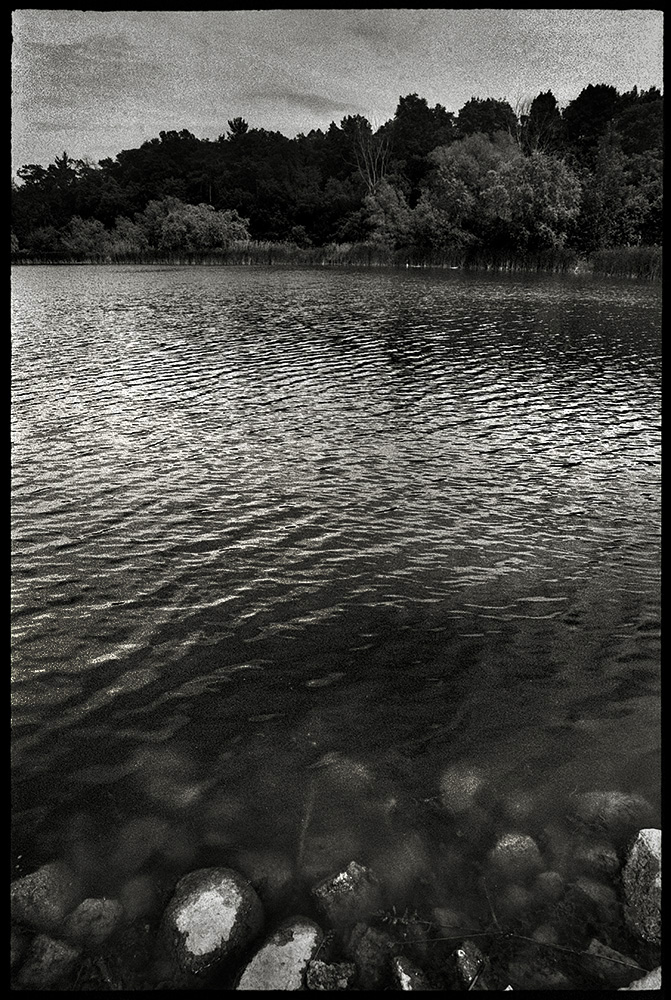
Topham Pond, Toronto, June 2018

I BOUGHT MY LAST REAL FILM CAMERA IN 2003. I've bought cameras since then - antiques and curiosities and some Lomography stuff, but they were either used as toys or meant to sit on a bookshelf in my office. The last new film camera I really used was the Canon EOS Elan 7e I purchased in 2003, after my trusty Canon EOS Elan (known in most markets around the world as the EOS 100) stopped working after a solid decade of hard use.

I knew when I bought it that the 7e would be my last film camera. Digital was happening in a big way, but the technology was still pretty hit-and-miss and the camera manufacturers hadn't come up with a single image file as the industry standard. I thought that I'd be using the 7e for at least three or four years when I packed it for my press junket to Peru - the camera's big shake-out cruise.


It's a pretty great piece of gear. Built out of alloys and polycarbonates like most of Canon's lower-priced cameras, it was on the top edge of their prosumer SLR line and included some pretty incredible technology, like an eye-following autofocus that worked really well, though it's never reappeared on any of Canon's subsequent cameras, amateur or professional. It was light and took all my old lenses and by the time I was back from Peru it seemed like we were ready to go.

I rarely ever used it again. The camera companies finally agreed on a common image standard - jpegs for compressed images and RAW files for uncompressed. With that settled, they could really begin competing with each other in the marketplace, which saw prices for cameras start to drop. In 2004 the free daily put me back to work shooting and bought a Canon digital SLR for me to use. The 7e was packed away in a camera bag and I don't think I put another roll of film through it again until last week.

Topham Pond, Toronto, June 2018

Knowing that I was going to be writing a blog post about the end of film photography, I pulled the 7e out of its bag in the basement, put some fresh batteries in the grip and loaded it with an expired roll of Ilford Delta 400 film I'd had sitting around since the camera was new. It only took a minute to decide that the most suitable subject on a warm June day was in my old neighbourhood, just a couple of blocks away from where Kodak Canada's plant used to be - the factory where women in my family worked since the '20s.

The pond on the southeast corner of the Eglinton Flats wasn't called Topham Pond when I was a kid. I don't recall it having a name (though I distinctly remember its stagnant odour in the heat of summer), and the parkland surrounding it was mostly grass and scrub with a few stands of shrubs and a single copse of trees at the bottom of the hill where teenagers went to smoke and make out. It's been landscaped and naturalized since I moved away over thirty years ago, and has become one of the nicest green spaces in the city, as far as I'm concerned.

Topham Pond, Toronto, June 2018

To compare and contrast, I also brought along my current favorite camera - the Fuji X-30 that has been a big part of the revival of my enthusiasm for shooting. There's no denying that the two cameras make me shoot differently, and that the images that come out of them have distinct qualities. Even if I didn't have to push the Ilford a stop to compensate for the lack of sensitivity of expired film, the grain in the film is hard to ignore, and has to be worked with when processing up the final images in Photoshop.

The digital files are very different - smooth and full of resolution when working from RAW files, and far easier to manipulate in editing. The film shots look like lithographs, full of rough analog texture, while the digital photos have a fine, long tonal curve that feels more like graphic art. It's easier to push and shape the digital files into something less realistic, and since the move to digital I've been able to realize effects that I could only imagine in the darkroom.


But the 7e wasn't my only final film camera. A year before I bought it, I walked into the one hour photo lab by the basement food court in the mall next to the free daily's offices and picked up an Olympus Stylus Epic on impulse. With my first steady paycheque in almost fifteen years, I was feeling flush, and I wanted a little camera I could fit in a pocket.

Until the Stylus, most point-and-shoot cameras were pretty dismal, but Olympus had produced a really useful bit of kit that, thanks to its bright, wide lens and an unusually accurate exposure system, had become a hit with professionals who used it to take notes, or even as a backup camera. It was the first small, inexpensive camera that I felt I could trust the way I've since learned to trust almost any recent digital camera - or the cameras in my smartphones, which have effectively killed off the point-and-shoot market.


Lunenberg wharves, Nova Scotia, Summer 2002
Barrington Street looking north from Sackville, Halifax, Nova Scotia. Summer 2002
Fog at Harbourville, Nova Scotia, Summer 2002

The Stylus was as indispensable then as my X-30 is today. I packed it with a Holga plastic camera on the Peru trip, and I actually have to look close to tell the difference between shots taken with the Stylus and the 7e. It was most useful of all on the summer trips we took to visit my wife's family in Nova Scotia, both before and after we had kids. I could use it for family snaps and for artier shots, like a short series I took holding up some of the vintage postcards I was collecting in the spots where they were taken.

If I'm honest, I don't miss film. I never really enjoyed the smell, the cost or the inconvenience of the darkroom, and I don't care if I ever develop another roll of film again. Image editors like Photoshop offer a complexity and ease of manipulation that has the added advantage of working anywhere - preferably in a comfortable chair by a window. But I feel bad that the 7e will never get used as much as its predecessor, and not just because it feels like I never got my money's worth out of its purchase price.


Wednesday, January 24, 2018

Rolleiflex


THE THING YOU HAVE TO REMEMBER ABOUT FILM PHOTOGRAPHY IN ITS FINAL DECADE OR TWO was that it hadn't seen any really major technological change since the '50s or early '60s. Film emulsions had gotten faster and autofocus lenses would become standard on 35mm SLRs, but a working photographer could - and did - continue using cameras bought at the beginning of their careers or built before they were born without losing any competitive edge.

I don't know precisely when I bought my first Rolleiflex, but it was somewhere around the turn of the '90s, when I got tired of the limitations in the primitive parallax correction system in my Mamiya C330, the first medium format camera I owned. The Rollei was a more elegant, compact piece of equipment, and it was much used by everyone I admired, from Cecil Beaton and Irving Penn to Richard Avedon and David Bailey.

I was also a committed Luddite in that first real decade of digital technology, home computers and the early internet, holding back the tide of transformation as long as I could in my studio full of gramophones and old records, vintage tailored suits, antiques, rotary dial phones and cast iron typewriters. It was a lifestyle I could manage as long as Macintosh computer systems for digital imaging cost as much as a new car and the first really usable digital cameras were somewhere on the other side of 9/11.

Helena Bonham Carter, Toronto, Jan. 1996
Robert Altman, Toronto, Sept. 1990

I had three Rolleis briefly, but my mainstay portrait cameras for most of the '90s were a pair of 75mm/3.5 models - a Schneider-Kreuznach Xenotar and a Zeiss Planar. They made their home in a very sturdy Pelican case with their lens hoods and a collection of bayonet filters, a Sekonic light meter and a cable release. Along with a lightweight Manfrotto tripod, they went with me into nearly every hotel room portrait session during that decade.

Most of my best portraits were taken with the Rolleis, either locked off on the tripod with a cable release or held close to my subject in a patch of nice window light. Working with the waist-level finder, with its dark, vignetted focusing screen and left-to-right reversed image, became second nature. The Rolleis were my babies, my comfort zone, my weapon of choice.


Their one major flaw was a minimum focusing distance of around three and a half feet, but that could be overcome with a close-up set - a pair of bayonet mount lenses, one for the taking lens and one with parallax correction for the viewing lens. If Irving Penn didn't have a problem with the slight distortion they created (very visible in my portrait of Robert Altman, above) then I wasn't going to complain, and I made them part of my shooting style.

If my Bronica SQ studio camera was a precision instrument, the Rolleis were like paintbrushes, and I always felt much more creative with them. They inspired me to do outlandish things, like the year or two I spent shooting a favorite local band with them, eschewing the fast shutter speeds and telephoto lenses most concert photographers favour for wild blurs and multiple exposures on the big, square negative of the Rollei.

Pure, Toronto, Oct. 1990

Most of all, I adored the square format of the Rollei, and found composing in it intuitive and satisfying. I didn't really feel at home with digital cameras until very recently, when I switched to the Fuji X series, which allows me to frame and shoot in the 1:1 ratio of the Rollei. I'll even use the tilting rear LCD screen on my Fujis like a waist-level viewfinder, swinging them around like the Rollei when I'm doing candids and street photography.

When editorial portraiture hit the rocks at the end of the '90s, I turned to my Rolleis for comfort, taking them out into the parks and streets and in my luggage when I traveled. Without a studio or steady clients, I went back to groping for that elusive image of the world I'd had in my mind's eye ever since my mom bought me a Kodak Instamatic for Christmas, long before I ever imagined anyone made a living taking photos.

High Park, Toronto, 1999
Hotel Place Bonaventure, Montreal, 2000

It goes without saying that I could never part with my pair of Rolleis after all we've been through together, and they still reside in their Pelican case, as if waiting for me to take them along the next hotel room portrait session.

I did dust off my "A" Rollei - the Xenotar - last year and took it along to my portrait shoot with the legendary conga player Candido Camero. It seemed appropriate - this was the sort of camera you'd have used to take his portrait back when he played with Dizzy Gillespie, Art Blakey and Stan Kenton.

To my dismay, I found it awkward to use - dim and difficult to focus and even counterintuitive. I had, in the decade-plus since I last ran a roll of film through it, lost the knack of the camera. The shoot was a success, but I still felt depressed when I got home and unloaded the Rollei. I felt like I had somehow let an old friend down.


Monday, December 11, 2017

Matthew Goode & Hayley Atwell

Hayley Atwell & Matthew Goode, Toronto, 2008

I WAS HALFWAY THROUGH THE NEW SEASON OF THE CROWN when I remembered that I'd once shot Matthew Goode, the actor who plays Tony Armstrong-Jones, the photographer who married Princess Margaret and became Lord Snowdon. Goode, coming off of Downton Abbey, makes a star turn playing him as sexy, mysterious and dangerous, shagging his way through several scenes with Margaret and others, most dramatically in Snowdon's dim and sinister Pimlico photo studio.

Thanks to my oldest daughter getting me hooked on the show, I was primed for the return of The Crown, but having a photographer as a major character (as a bonus, Cecil Beaton appears as a minor one) couldn't help but amplify my interest. With his stygian shooting space and rich aura of charisma and rebellion - accessorized with a vintage Triumph motorcycle - Goode's Snowdon is probably the best advertisement for my trade since David Hemmings in Blow Up.

Most of an episode is taken up with Margaret and Armstrong-Jones and their mutual seduction, much of their initial meeting being a discussion about portrait photography, followed by a photo shoot. That shoot, played out in the dim light of his studio, is meant to contrast Snowdon's audacious, edgy shooting method with the obsequious deference of Beaton during an official portrait session with Margaret just a few scenes previous. I can't remember the last time that the style and aesthetics of portrait photography played such a key part in a historical drama.

Poor Beaton comes in for a beating in the show, dismissed by Snowdon as "a disgrace" and played for comic effect, reciting corny odes to the monarchy and England as he stands next to his big view camera, a minor courtier full of deference for the establishment, unlike the dismissive young Snowdon. It's an unfair caricature, but I'll always be first in line to defend Beaton, who was so important in making me see the art of portrait photography.

Hayley Atwell & Matthew Goode, Toronto, 2008

The Crown also exercises considerable license with facts and timelines. The sensuous, glamorous portrait that Snowdon takes of Margaret during their first session together wasn't actually shot until years later, after they were married. Even more puzzling is a scene where Snowdon, engaged in a friendly menage a trois with a married couple, is reminded that he'd said that Margaret had "thick ankles and the face of a Jewish manicurist." The real Armstrong-Jones might have said this, and it might have been true of the actual Princess, but it certainly doesn't apply to Vanessa Kirby's onscreen Margaret.

Most annoying of all - at least for photographers - is Snowdon taking the princess into his basement darkroom to see the results of their shoot. He walks up to the enlarger holding his loaded Leica and a moment later is making a print. A generation who takes for granted that photography is an instant art won't notice, but as someone who has spent a lifetime sum of literal weeks souping film, it had me spitting.

Quibbles aside, Goode is fantastic as Snowdon, a man whose immense confidence and talent blind him to the certain trauma that he's about to bring upon himself and a woman wholly incapable of enduring real pain. I photographed him almost ten years ago for the free national daily, together with Hayley Atwell, who was co-starring with him in an entirely unnecessary movie adaptation of Evelyn Waugh's Brideshead Revisited. (The 1981 Granada miniseries starring Jeremy Irons was the definitive version, for either large or small screen.)

The shots aren't anything special - a competent snapshot of a pair of actors toying with the chemistry they developed on set, like a party trick they learned together. Much of my work for the free national daily was like this - merely competent, exercised with no particular concern with style or lasting quality. I was shooting to fill a hole either one or two columns wide in a layout, if it ran at all, so the most I concerned myself with was sharpness and exposure and a clean graphic that wouldn't clutter up already busy newsprint pages.

If I cared about future re-use or resale I might have pressed Goode and Atwell for individual shots, though that would have tried the patience of publicists who saw portrait sessions as something dispensed with in seconds, if possible. Goode met my camera lens with the clear gaze of a man resigned to being handsome; the intervening years have lined his face and chiseled his features even further for his turn as the seductive Snowdon. Rediscovering this shoot with a prompt from his role in The Crown only makes its perfunctory nature seem like a missed opportunity - one of many.


Wednesday, November 15, 2017

Sally

Sally Lee, film test, Parkdale, April 1991. Kodak VPS rated at ISO 20, pushed 1 stop, 30R filter

MY RECENT POST OF OLD FASHION PHOTOS featured some shots of Sally Lee, my onetime roommate in the Parkdale loft and sometime model for my studio experiments. When I was scanning those shots, I remembered that one of the thankless favours I asked of Sally was being the model for my attempts to calibrate the results of cross processing colour negative film through E-6 chemistry.

While it's true that Sally was a convenient model, living as she did in the next room, I'd be lying if I didn't admit that I knew that scrutinizing rolls of slide film for contrast and tonal shifts would be generally more pleasant with an attractive model. She was agreeable enough to stand in front of one of my strobe lights for two sessions in the spring of 1991, holding up my homemade colour chart while I changed filters and made notes on f-stops as I worked.

Sally Lee, film test, Parkdale, April 1991. Kodak VHC rated at ISO 20, pushed 1 stop, 40M filter
Sally Lee, film test, Parkdale, April 1991. Fujicolor 400 rated at ISO 50, pushed 1 stop, 40M filter open 1 stop

I'd first seen cross-processed photos in American music magazines, in work by people like Michael Lavine. Not long after my predecessor at NOW magazine, photographer Chris Nicholls, had done some early work with cross-processed slide film, and he was kind enough to sit down with Chris Buck and I in an east end diner and give us some basic tips on how it was done.

He said that you could cross-process both ways, but that you needed to do a lot of testing to see how pushing and filters and exposure would effect the results, especially when working with colour negative film. After some early success with slide film-turned-negative, I picked up a variety of negative films and tried to find something workable. I carefully recorded my results and offered them to anyone who wanted to try it out, figuring that it was better to share information than hoard it.

In the end, negative-through-slide cross-processing turned out to be too unpredictable to work with, though I'd keep going back to slide-through-negative cross-processing on and off for the next decade, looking for a way to get punchier colours and interesting historical effects. Nowadays almost all of this can be approximated roughly in Photoshop, though to my eye there's always something specific and unique to film chemistry - some peculiarity in the tonal shifts - that no one has ever been able to recreate digitally.

Sally Lee, film test, Parkdale, April 1991. Fuji Reala rated at ISO 12, 85 filter
Sally Lee, film test, Parkdale, April 1991. Kodak Ektar 25 rated at ISO 3, pushed 1 stop, no filter, closed 1 stop
Sally Lee, film test, Parkdale, April 1991. Agfa Portrait 160 rated at ISO 20, 85 filter closed 1 stop

How I ended up living with Sally is another story. She was, by the time I took these shots, my ex-girlfriend's sister, or very nearly. The three of us had moved into the Parkdale loft together, subletting the space against the wishes of a rogue landlord who tried to force all the tenants out with intimidation and threats. Sally's sister broke up with me after moving to New York City to study, leaving us in a somewhat awkward living situation.

We lasted a year after the breakup as roommates before it got all too much for Sally and she moved out. I was so desperate to have a shooting space that I was apparently willing to endure thug superintendents shoving toothpicks in my door lock, writing threats on our door and blaring country radio in the empty unit next door, along with the emotional awkwardness of living with the sister of my ex, as nice as she could be. I'd end up living in that loft for the rest of the decade, though the landlord and his thugs were gone not long after I took these photos.

Sally's essential likability has always made her popular in Toronto's overlapping worlds of art, music and film, where she's worked since we were roommates. I've always felt that I must have tested her amiability with my own basically grouchy temperament, not to mention my increasingly fragile emotional state during and after the break-up with her sister, but we've somehow managed to stay friendly in spite of it all. She took up the bass while we were living together, and she's till at it today, playing with our old upstairs neighbour Don Pyle in a new band. I'd like to post these old photos as a belated thank you, both for helping me out and for enduring.