Showing posts with label street photography. Show all posts

Wednesday, September 12, 2018

Digital

My Olympus gear

THE DIGITAL REVOLUTION WAS COMPLETE by the time I was laid off by the free daily. It's not the most revolutionary thing that happened to photography in the last twenty years; it's close, but the wild changes that transformed the business (and the art) of photography happened alongside some other trends, some economic, some social, some aesthetic. All I know is that I had a ringside seat for it all.

When I started my gig with the free daily as the interim photo editor I still used film and my desk featured a much-used (and occasionally cranky) Nikon Coolpix 35mm film scanner. When the paper sent me to Peru I went with the very nice Canon 35mm SLR that I'd just bought, assuming that it would hold me over for a few years until they'd ironed the bugs out of usable digital cameras. The bugs were ironed out in less than a year, and I barely ever used the camera again.

The Canon cameras I used at the free daily

When Jodi, my editor at the free daily, put me back to work as the paper's photographer they bought a consumer level digital camera for me to use. In a couple of years it had become inadequate to the task and they replaced it with a much better Canon - a prosumer model that was in my hands for most of the time I began to start thinking (very quietly) about myself as a professional photographer again.

One of my beats at the paper was writing a technology review column, which meant that I had new digital cameras in my hands all the time. I reviewed digital SLRs and point-and-shoots by all the major manufacturers, including Canon, Nikon, Kodak, Panasonic, Leica, Sony and Olympus. The churn was pretty fierce as every generation of camera added new features and nearly doubled the size of the image sensors.

Some of the cameras I reviewed for the free daily

There were some interesting experiments - I particularly liked the Olympus E-330, which did away with the hump of the viewfinder prism somehow - but the basic form of the DSLR didn't end up really changing, and digital cameras on the market today still ape either film SLRs or Leica-style rangefinders.

It took me a lot longer to figure out how and why a digital image was different from a film negative. Some of the work I was processing as a photo editor at first was shot on film and scanned to digital, but while it very quickly became wholly digital, it was hard to concentrate on the difference in the heat of deadlines and the new speed and convenience of doing away with film processing and darkrooming.

Harbourfront, Toronto, 2011

It wasn't until a couple of years after I'd been laid off that I had time to think about how digital photography was visibly different from film. The catalyst was the shot above, taken while I was walking around the city's old harbour while on assignment for blogTO. It was a shot I took when the view caught my eye - the sun barely burning through a midday haze and giving an eerie light on a bunch of upturned boats by a sailing school.

There was a time when I might not have bothered taking the photo; I tried to keep my expenses as low as possible when I was a freelancer and, combined with my frugality, I might not have wanted to waste any frames when I had to save film for a job. That was the first thing that changed with digital photography.

I had hoped that the shot would turn out well when I snapped the shutter. It helped to be able to preview it on the LCD screen on the back of the camera, which let me know that I had something to work with before I was at home and in front of a computer. Taken together, it's hard to deny that digital photography gave me a control and confidence from the moment I took the camera out of the bag that I don't think I ever had with film, and for that I was grateful.

And finally there was something about the quality of the image - the lack of grain and a peculiar luminance that I began seeing in digital photographs as soon as the resolution passed a certain threshold and became competitive with higher ISO film at the very least. It's hard to explain, but I don't think that the shot above would have looked the same way even if I'd taken it on a roll of slide film. There's something about the way a digital photo arranges itself on the pixel level that it took me a long time to anticipate when I worked.

Olympus gear, 2018

When I was laid off I had to return the Canon SLR to the paper. I had developed a nice relationship with the PR company that worked with Olympus while writing the tech review column - I really liked their cameras. After the lay-off I contacted them to say that I had a whole bunch of Olympus gear that I was either finished with or hadn't had a chance to write about yet, and asked them how I should return it to them.

It goes without saying that I was pretty broke after being laid off, and both unwilling and unable to budget money for a new DSLR. That could have been the end of my photography career - again - but Olympus' PR told me not to worry. They said the gear had been written off anyway, that I should keep it, and thanks for all the good press I'd given them over the last few years. I think they might have felt sorry for me.

It was, in any case, an incredible gift, and if I believed in such a thing, it was almost a sign that I shouldn't give up on photography, even if my circumstances had never really been worse. I have used these cameras happily and often over the last decade, and I still have a feeling of fondness and regret when I pull them out of their bag now, having just made the switch to Fuji mirrorless cameras.

Man covered in bees, Canadian National Exhibition, 2011

The image above is perhaps my best argument for digital photography. I only rediscovered it in my files a couple of months ago, and the original didn't look much like this at all. Shot in harsh late morning sunlight with my Olympus E-30 at the media preview day at the CNE for blogTO, it was originally a horizontal 3/4 shot, in colour. The background was distracting and the light a bit harsh, but with a lot of work in Photoshop with the clone tool and serious manipulation of layers, I was able to produce something that looks like a studio shot.

You could, of course, manipulate film images. It required hours of work and costs in paper and chemistry even if you didn't end up re-photographing the photo on the way to making a relatively seamless composite. It was the sort of work I tended to avoid then, but rarely shy away from now - the creative options available with a digital image are almost limitless, and it's made me a more technically competent photographer than I could ever have been with film.

There have, of course, been major changes to photography that have nothing to with cameras and more to do with the way we produce and consume photographs. They have been, by and large, proof of the most extreme scenarios imagined by Joseph Schumpeter's "Creative Destruction." The launch of Instagram was over a year away from the lay-off that changed the direction of my "career" once again, but that's a subject for another post.


Friday, June 8, 2018

Chicago

Grant Park, Chicago, winter 1999

AFTER BARCELONA, THE SECOND TRIP MY FUTURE WIFE AND I TOOK WAS TO CHICAGO. She had to cover a housewares convention and I decided to tag along; I'd been to the city at least a couple of times before, shooting covers for NOW magazine, and I liked it. Chicago occupied some sort of middle ground between Toronto and New York City, in terms of size and scale and urban density, and as a result felt very familiar from the first time I went there.

We decided to take the train - VIA Rail from Toronto to Windsor, then Amtrak once we'd crossed the border at Detroit. Along the way we got a nighttime glimpse of the horror that is Gary, Indiana, and an up close encounter with the gentle manner of pre-9/11 American Customs and Border officials. ("Next time you're here ya should learn English," bellowed the lady with the badge and gun at the pair of frightened Japanese grandmothers in our train car. Seriously America, I love you, but you've got to find better people to work as your greeters.)

Amtrak from Toronto to Chicago, winter 1999
View from Marina Towers, Chicago, winter 1999

Our accommodation was provided by a novel precursor to Airbnb - a (now defunct) service that rented out spaces in heritage buildings for tourists. We managed to snag the home of one of the owners of the service - an apartment in the iconic Marina Towers building right on the river in downtown Chicago. (Soon to be made even more iconic by the cover of Wilco's Yankee Hotel Foxtrot record.)

I brought just two cameras with me for the trip - a Rolleiflex, and a disposable Kodak panoramic camera. I'd been a fan of the FunSaver panoramic camera since Kodak brought them out in the late '80s. I'd always wanted to own a proper panoramic camera - a Widelux or a Linhof Technorama or a Fuji GX617 or a Noblex - but I could never afford more than a rental, so I mostly had to console myself with the Kodak. The FunSaver wasn't a true panoramic; it just shot a cropped 35mm frame instead of a stretched negative, but its grainy results were intriguing, and in 1990 I was in a group show - my first ever - featuring photos taken with the FunSaver.

Under the El, Chicago, winter 1999
Grant Park, Chicago, winter 1999

Chicago was in the depths of winter when we arrived, under a fresh snowfall. While K went off to the convention centre for her show, I headed out to Grant Park with my cameras, detouring via the El and the old downtown. Down by the lake the city seemed deserted, and I ended up with some pretty somber shots on my roll. The view at the top of this post, by the way, isn't there any more - the Harrison Hotel is a Travelodge now, and the view to where its sign would have been has been filled in by a big, glass-fronted building.

These photos might make our Chicago trip seem like a bleak affair, but we actually had a lot of fun. We ate dinner at the old Berghoff and Rick Bayless' Topolobampo, and spent an amazing afternoon at the Chicago Historical Society's museum - a model for any city museum. We had dinner at my super successful cousin Donna's massive loft near the El and - at K's insistence (she was writing a story) - did high tea at American Girl Place.

The latter was apparently a test; K wanted to see how I'd deal with such a hyper-girly experience; what I remember isn't the strange looks I got as a man in the very male-free room, but us as a couple eating there without a child. Notwithstanding, I apparently passed the test, which would prove useful a few years later when we became parents to daughters.

View from Marina Towers, Chicago, winter 1999

Friday, May 11, 2018

Downtime

High Park, Toronto, 1999

I NEVER STOPPED TAKING PHOTOS. I only stopped making a living taking photos. That's one of the things I've learned while going through my files for this blog. If I had stopped taking photos because my full-time career as a professional photographer had effectively ended there would be no point doing this, because that would mean that I was never really a photographer.

A few months ago I found a Kodak Instamatic camera in a second hand shop, the same model as the one my mother gave me for Christmas when I was a boy - my first camera. I remembered how I'd gone out into the snow outside the house and took photos that interested me: Shots of snow drifts in front of bare trees and dormant hedges, everything composed in what I would learn later were the rules of seconds and thirds. I'm still trying to take those photos nearly fifty years later, and back when I was relieved of the pressure of taking photos for money, that's what I did with my copious downtime.

High Park, Toronto, 1999

I have lived in the west end of Toronto for nearly my whole life. The parks and beaches and industrial precincts of the area have always been where I've gone to reflect and recharge, places full of personal and family history. This is what my hometown looks like in my mind, and every photo I've taken there is an attempt to fix that place and what it looks like in memory and posterity.

I took my Rolleiflex along on family vacations to visit my in-laws in Nova Scotia, fascinated by a place that didn't look like anywhere I'd lived before. This is the landscape of my wife's family and memories, so shooting there was like trying to tell someone else's story without using their words. The shore of the Bay of Fundy, with its shingle beaches and outcrops of volcanic rock, is one of the most primal places I've ever been, with a harshness that I find mysteriously appealing.

Lunenburg, NS, 2003
Harbourville, NS, 2003

Back home, I returned to Mount Dennis, where I took my first photos a few blocks from the Kodak plant where my family worked, and around the west end I know so well. I ended up documenting not just the place where I grew up, but also Parkdale, where we lived, and the old working class and industrial neighbourhoods around Earlscourt and Silverthorn, where we'd end up moving several years later, and where I'm writing this now. Short of family photos or self-portraits, these are probably the most personal photos I've ever taken.

They were also the last outings I'd make with my Rolleiflex. The year after I took the last of them I was put back to work shooting for the free daily, using the first really practical digital cameras. The whole slow, segmented process of shooting with a camera like the Rolleiflex became obsolete and impractical practically overnight, so these photos are effectively my farewell to film photography, though I didn't know it at the time.

Mount Dennis, Toronto, 2001
Junction, Toronto, 2003
Silverthorn, Toronto, 2003
Parkdale, Toronto 2003

Wednesday, May 9, 2018

Peru

Machu Picchu, Peru, 2003

IN THE SUMMER OF 2003, MY EDITOR AT THE FREE DAILY ASKED ME IF I'D LIKE TO GO TO PERU. He had run into somebody from their trade commission at a party and it had led to an invite to attend Peru Xport, a trade fair happening in Lima that September. He was either unwilling or unable to attend, so he asked me to go instead, maybe write an article or two, perhaps post a diary about the trip on the paper's website.

It would have been terribly selfish of me to say yes. We had a baby at home and, although my wife was on maternity leave, she'd be a new mother left alone for five days. She was also an ex-journalist from a family of journalists, who understood better than I did when an editor's request was anything but, and that it was best for me to accept. For my part, I had lived a very untraveled life, and was eager to go anywhere at all, never mind a place as exotic as Peru.

And so I found myself on a plane and, after a brief night's sleep in my hotel in Lima, on another plane early the next morning to Cusco, for a quick trip to Machu Picchu before the trade fair began, all paid for and organized by PROMPEX, Peru's trade commission.

Machu Picchu, Peru, 2003

I would recommend that anyone should visit any marvel of the world if you ever have the chance. Great Wall of China, the Great Pyramids at Giza, the Grand Canyon; anything that's incredible or improbable or awesome, whether man-made or not, will lift you from the banal and workaday, at least for a while. I had never imagined that I would see Machu Picchu until I was actually on the Peru Rail train heading there from Ollantaytambo to Aguas Calientes, the town where you get off the train and catch the bus to Machu Picchu.

It's fascinating that no one really knows the actual purpose of the ruins, which were only discovered just over a century ago by the explorer Hiram Bingham. There are educated guesses and vague descriptions ascribed to certain areas - the Guardhouse, the Temple of the Sun, the Room of Three Windows - but the only thing we know for certain about Machu Picchu is that it took an awful lot of effort to bring the building material and labour up from the valley floor to this breathtaking saddle between two mountains.

As for Bingham's discovery of the place, it's likely that it was found and plundered at least twice in the 19th century, and it appeared on maps in 1874. When Bingham arrived, there were families already living there, hauling up soil from the Urubamba river valley to the Inca terraces. I can tell you that the llamas that roam the site, acting as groundskeepers, are pretty scary when they come at you while you're walking along a narrow path without guardrails hundreds of feet above the valley floor.

Machu Picchu, Peru, 2003

The altitude sickness that I'd managed to avoid all through the trip to and from Machu Picchu hit me with full force that night in Cusco, but thanks to some coca leaf tea and the pure oxygen piped into my room at a very nice hotel, I woke up the next morning feeling better. Juan Jose, my minder from PROMPEX, took me for a wander around Cusco and then up to the hills above the city to the ruins of Sacsayhuaman.

In a way, Sacsayhuaman is more impressive than Machu Picchu because of its walls, built with massive stones chiseled to fit together like a jigsaw puzzle. While much of the site was demolished for materials to rebuild Cusco as a Spanish colonial capitol, enough remains to be awe-inspiring, with the added bonus of being largely unvisited by tourists compared to the famous city in the clouds.

Cusco, Peru, 2003
Sacsayhuaman, Peru, 2003

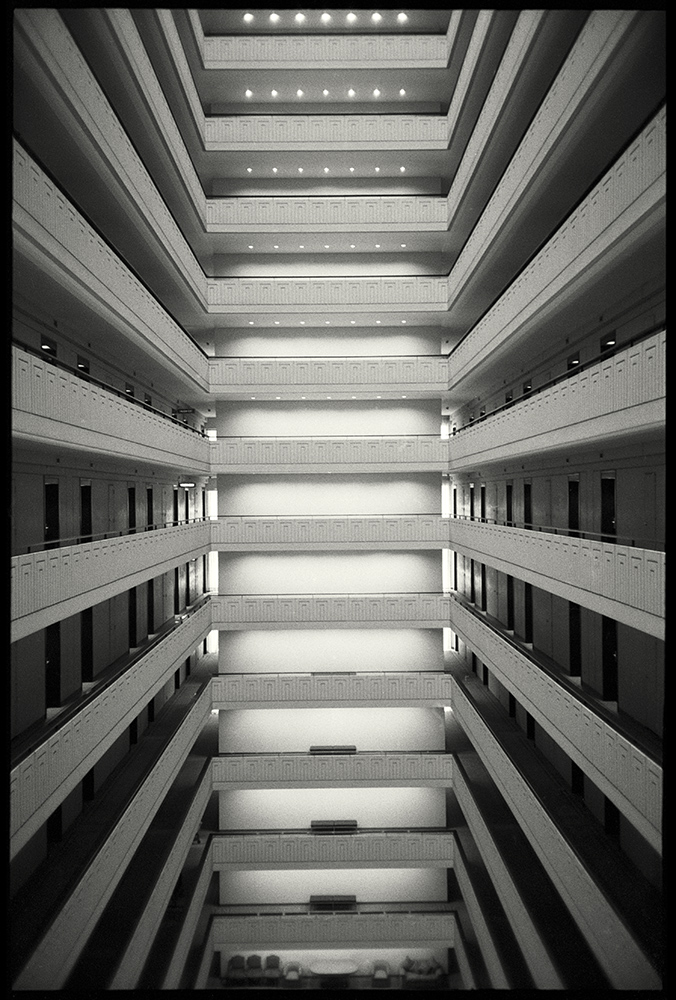
Back in Lima, we got about the real purpose of my visit - the trade fair and the business of publicizing Peru's resources and products. I stayed in the Sheraton Lima, with its rooms laid out around a vertiginous atrium lobby that was almost as awe-inspiring as Machu Picchu. The fair itself was held on the grounds of the Pacific International Fairgrounds - an annual fun fair rented out for the occasion. (Don't look for it now - it was demolished not long after I was there.)

Over the course of the next two days I saw my second fashion show of the trip (the first one was on the train to Machu Picchu), talked to people dealing in everything from minerals to sweaters, ate a lot of food and drank a lot of pisco sours. At one point, standing around idly with Juan Jose, we were suddenly enveloped in the security entourage around the First Lady, wife of then-president Alejandro Toledo, and shifted along with it to a line of armoured SUVs, surrounded by a dozen hawk-faced men with mirrored shades and earpieces.

Sheraton, Lima, Peru, 2003
Pacific International Fairgrounds, Lima, Peru, 2003
Fashion show, Lima, Peru
Paraglider, Lima, Peru, 2003

At one point I finally got away from the trade fair and got a tour of the city when Juan Jose took me to interview the CEO of a mining company at his private club in Miraflores. My research for the trip had mostly consisted of reading Nicholas Shakespeare's novel The Dancer Upstairs, about Peru during the years of the Shining Path's terrorist bombings, and the movie version starring Javier Bardem.

It was amazing that the city had only recently experienced regular bombings and assassinations. Peru's government had become a major proponent of economist Hernando de Soto's "microfinance," which filled the streets with vendors and private bus lines. Once, while waiting with Juan Jose at a stop light, a hawker approached our cab with a big cardboard placard covered in bootleg DVDs - including a copy of The Dancer Upstairs.

Pacific International Fairgrounds, Lima, Peru, 2003
Lima, Peru, 2003

I took a lot of photos when I was in Peru. My workhorse SLR since the early '90s, the Canon EOS Elan, had finally given up the ghost not long before, so this was my debut outing with a really impressive new camera - the Canon Elan 7e, packed with more features than I ever imagined in the old EOS, including eye-following autofocus, a truly magical bit of wizardry that, for some reason, Canon hasn't featured in any of its subsequent digital cameras.

I bought the 7e knowing that it was probably my last film camera, and expected to be using it for at least a few more years. Peru was, in fact, the last time I would use it seriously, as the free daily would buy a Canon DSLR for me to use a few months later. The Peru trip was my first real shooting job in at least two years, and I had obviously decided to keep things simple - there's an awful lot of symmetry happening in these shots, and subjects located directly in the centre of the frame.

I had hoped that a long lay-off from taking photos would revive some of the inspiration I felt I was losing at the end of the '90s, when the frustrations of a flagging career had made me second guess myself more than I usually did. Clean, clear, unfussy - I wanted to find my way to taking photos that could be described this way, and I was encouraged by the results when I got back all those rolls of film from the printer. I particularly liked these photos of Inca mummies taken at the museum of archaeology in Lima. They looked like I felt.

Inca mummies, National Museum of Archaeology, Lima, Peru, 2003

Friday, April 13, 2018

Holga 2

Lunenberg, NS, Summer 2003

MY HOLGA PLASTIC CAMERA SAT ON A SHELF FOR THREE YEARS. As much as it had pointed me in a new direction just when I needed inspiration, life had not been so generous. I guess I needed a bit more than inspiration, because those three years were full of changes, not all of them positive. The worst was that no one wanted to hire me to take photos any more.

Ten years earlier I had been an emotional wreck, but I had plenty of work, and that doubtless helped me get through what I can only describe as a five year depression. At the beginning of the new millennium, I became a husband and a father but could no longer describe myself as a working photographer. With no one but myself as a client and an audience, I took the Holga down from the shelf again.

Brockton, Toronto, 2003
Junction, Toronto, 2003

I've always looked to photography's old masters for inspiration, and in 2003 it was Eugene Atget, the photographer who documented a Paris that was being modernized out of existence. Not coincidentally, he worked in obscurity for almost all of his life, and achieved recognition after his death. I figured that since nobody wanted to hire me any more, I was free to take the photos I never had the time to make.

I have lived in Toronto my whole life, and my family's been here since World War One. Except for two brief periods, I have always lived in the west end of the city, within walking distance of the lake, High Park or the old Grand Trunk train lines. The city I grew up in, much like the one Atget set out to document, was changing rapidly, and I wanted to fix my own memories of the place while I could, and that mostly meant the alleyways that run behind the streets and the industrial districts bordering the rail lines.

High Park, Toronto, 2003

The only place I couldn't imagine changing was High Park, probably the biggest green space I ever saw as a kid, and one where I was taking my own kids almost weekly. It was the best part of the city I knew intimately, and the Holga captured it like I saw it in my mind - dreamlike and timeless, like a memory's flawed snapshot.

I also took the Holga with me on a summer trip to visit my wife's family in Nova Scotia, and her grandmother's cottage on the Bay of Fundy. This was a landscape I didn't know from either my childhood or my memories, so it felt much stranger to me when I framed it in the Holga's ad hoc viewfinder.

Harbourville, NS, Summer 2003

I had a lot of pent-up creativity the year when I took these pictures, which wasn't getting much of an outlet while I sat a desk at the free daily processing other people's photos. After using Nikons and Rolleis, Bronicas and Canons for so long, the Holga became my main camera for a year, and pretty nearly my sole outlet for whatever images I wanted to make, though I doubt if many of these shots ever made it off a contact sheet.

Finally, as the year ended, I was sent on a strange, unexpected press trip to cover a mining fair in Peru, and brought the Holga along in my bag, along with what would end up being my last film SLR. (More on that later.) In a place so far from either Toronto or Harbourville, the Holga was the perfect camera to seize on what I was seeing - truly alien landscapes to my eye, ancient and overwhelming.

Macchu Picchu, Peru, 2003
Cusco, Peru, 2003

As simple as a snapshot camera, the Holga produced images that looked like hundred year old plates from a bellows camera. That timeless quality felt more like something I found than a job I'd sketched in a notebook and created using tools and technology it took years to master. In the final years of film, with a new technology about to overwhelm that old chemical process, I rediscovered the magical quality of photographic imagery that makes it far more than just a visual transcription of a scene. A cheap plastic camera made image making fun again at a point where I didn't imagine it would ever be more than a hobby.