Wednesday, July 11, 2018

Giovanni Ribisi

Giovanni Ribisi, Toronto, March 21, 2007

YOU WANT IT DARKER? I must have wanted it darker on the day I photographed Halle Berry and Giovanni Ribisi at the Windsor Arms Hotel, judging by the results. The actors were in town publicizing the film Perfect Stranger; co-star Bruce Willis had obviously been unavailable but I didn't mind as I'd been enjoying Ribisi's work for years by that point, and continue to do so today.

As I explained with the Halle Berry post, I showed up for this shoot with a camera I was reviewing - Sony's a100, the first DSLR in their camera lineup. A prudent photographer would have done some tests to see how it performed in the challenging circumstances of my hotel room shoots, but I didn't. Imagine my shock when I walked into the rooms at the Windsor Arms to be reminded that it was a hotel with tiny windows letting in scant light.

Still, I've shot using available light for so long that, as far as I'm concerned, any light is good light. But the Ribisi shoot wasn't about making do with poor light like the Halle Berry shoot I did the same day - the light I found in the room where I shot Giovanni Ribisi was amazing! Dim, but amazing, which means that I've worked especially hard to make these shots turn out years after they were taken, to overcome the technical limitations of the source image.

Giovanni Ribisi, Toronto, March 21, 2007

As I said before, the Sony a100 didn't perform particularly well in low light. Perhaps if I'd shot RAW in addition to jpeg I might have had something richer to work with, but I've only started shooting uncompressed files recently. (A shameful admission, I know.) With the Halle Berry shoot I was disappointed that I couldn't find a really lovely piece of light and had to improvise, but even though I loved what I was seeing through the viewfinder with Ribisi, I knew I'd have a hell of a time making them workable for newsprint.

This is a case where I was actually taking photos with some future use in mind, beyond the job at hand. I just didn't know that this future use would be this blog. The dim but dramatic side light looked like something from an old issue of Esquire, or a British Sunday weekly magazine in the '60s, and seemed appropriate for Ribisi, who's more like the sort of actors that mixed character with leading man, back when movies were generally more interesting.

The problem was that I was working for a newspaper - I had, in fact, always worked for newsprint publications - where highlights need to pop and really dark shadows just suck up ink. This is probably the biggest disappointment I had to live with for most of my career, and the reason why I've only recently been able to present my work the way I always saw it in my mind - without a client to pay for it, to be sure, but very nearly the way I always wanted it to look.

Giovanni Ribisi, Toronto, March 21, 2007

Tuesday, July 10, 2018

Halle Berry

Halle Berry, Toronto, March 21, 2007

WHAT AMAZES ME IS THAT THESE PICTURES TURNED OUT AT ALL. I photographed Halle Berry in a room at the Windsor Arms hotel when she was in town doing publicity for Perfect Stranger, a thriller where she co-starred with Bruce Willis. A few years earlier I'd have just been surprised by getting a session with someone like Berry - a real celebrity and movie star, a Bond Girl and the winner of an Academy Award.

But by 2007 I was accustomed to having access - however brief - to some pretty big Hollywood names. I was still wrestling with the challenge of trying to push for something even faintly dramatic in the scant minutes (really seconds) I had with them, so I'm amazed that I chose to walk into a shoot with Berry holding a camera I'd never used before, into a situation where finding decent light had proved to be difficult in the past.

I'd added the role of tech column writer to my list of responsibilities at the free daily, and naturally I liked to review new cameras, like the Sony a100 I was using that day. While there was a bit of accidental synergy happening with this - Perfect Stranger was released by Sony Pictures - I was taking a bit of a risk by trusting the results of my shoot to the first-ever DSLR made by the company.

Halle Berry, Toronto, March 21, 2007

It turned out that the a100 - like quite a few of the early digital SLRs at the time - had a bit of an issue with shooting in low light. And the Windsor Arms, while a luxurious hotel, was notable for its small windows and lack of daylight (especially compared to hotels like the old Four Seasons a block or two away.) I knew as soon as I saw the room that I'd have a lot of work to do in Photoshop.

It wasn't that Berry needed the work. Far from it - she was as lovely in real life as she appeared onscreen. But the light was poor and lacked vibrance or focus, and I was going to lose quite a bit of detail by shooting at ISO 1600. Additionally, the autofocus system on the a100 had a hard time locking onto Berry in the dim room, reducing the number of really usable shots.

There's no shortage of really glamorous photos of someone like Halle Berry out there; I knew that my portraits wouldn't be among them. These shots work - if they work at all - as vaguely arty snapshots of a person who photographs really well, but who knows that her bare minimum in front of a camera will come off so much better than most other people. The technical limitations of my equipment and the shortcomings of the location combined to create what I would have considered at any other time in my career to be an unacceptably narrow window of success.


Monday, July 9, 2018

Billy Bob Thornton

Billy Bob Thornton, Toronto, Jan.30, 2007

IT WAS NO SECRET THAT BILLY BOB THORNTON COULD BE DIFFICULT. His reputation - founded on a perfectly reasonable distaste for celebrity culture - preceded him, and I knew that my shoot would be short (no surprise - they all were) and that I wouldn't get more out of him than he was willing to give depending on his mood.

Which potentially meant nothing; until I had my camera in my hand and Thornton sitting in front of me in a suite at the old Four Seasons in Yorkville, I was prepared to learn that there would be no shoot happening with him at all. With this in mind, I found the best piece of light I could - easier at the Four Seasons than most other hotels - and met his eye briefly, in the hope of establishing the bare minimum of a connection before I began shooting.

Billy Bob Thornton, Toronto, Jan.30, 2007

For many photographers - and a lot of publications - something like this might be enough. As a younger photographer impressed that I came away with anything on a roll of film, I might have been content with it, but Thornton's difficult persona was intriguing, and I wished I'd had the opportunity to get him to express something more than a passive engagement with me and my camera as representatives of the media-celebrity machinery he barely tolerated.

My friend Chris, for instance, had managed to produce a really indelible image of Thornton a few years earlier. It was obviously nothing that I could ever hope or want to reproduce, but I can say with some authority that this was the point in my career's "second act" where I was becoming frustrated with rising to the level of merely inspired competence, just out of reach of situations where I could try to elicit another level from my shoots - a bit more of the "editorial" part of editorial photography.

A FOOTNOTE: I found the image below in the folder for this shoot, right at the top of the sequence of frames. I was testing out cameras for a tech column I was writing for the free daily and the nice people at Olympus had lent me a fisheye lens to go with one of their E-330 DSLRs. I must have put it on the camera and handed it to Chris Atchison, the writer, while we were waiting for Thornton to arrive, and he obviously clicked off this single frame. I have very few photos of me at work; this is one of the few, and a helpful clue to just what movie Thornton was in town promoting.

Waiting for Billy Bob, Four Seasons Yorkville, Toronto, Jan. 30, 2007

Friday, July 6, 2018

The End of Film

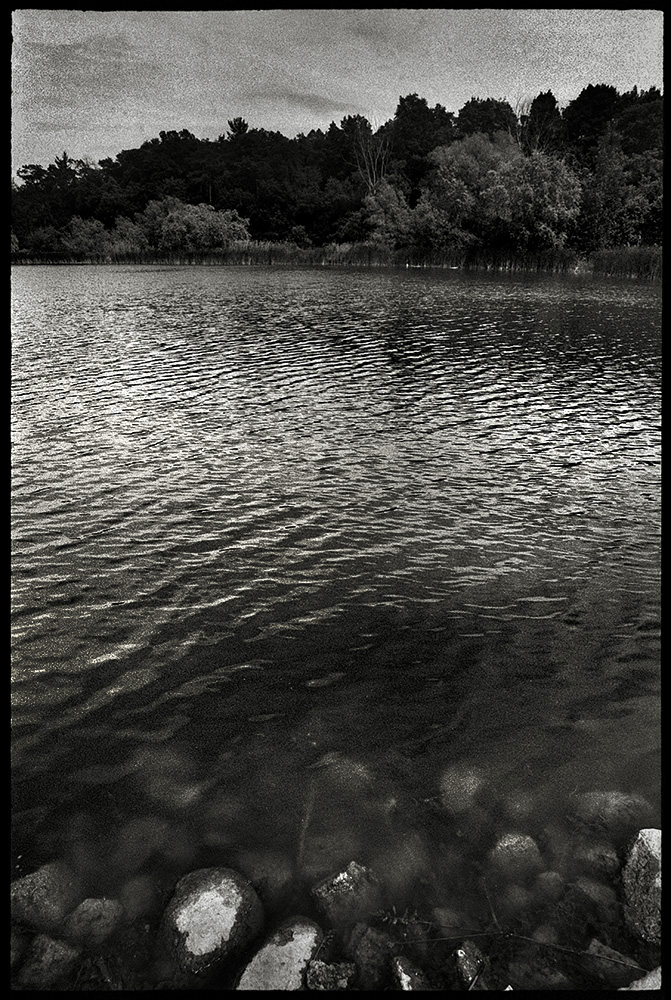
Topham Pond, Toronto, June 2018

I BOUGHT MY LAST REAL FILM CAMERA IN 2003. I've bought cameras since then - antiques and curiosities and some Lomography stuff, but they were either used as toys or meant to sit on a bookshelf in my office. The last new film camera I really used was the Canon EOS Elan 7e I purchased in 2003, after my trusty Canon EOS Elan (known in most markets around the world as the EOS 100) stopped working after a solid decade of hard use.

I knew when I bought it that the 7e would be my last film camera. Digital was happening in a big way, but the technology was still pretty hit-and-miss and the camera manufacturers hadn't come up with a single image file as the industry standard. I thought that I'd be using the 7e for at least three or four years when I packed it for my press junket to Peru - the camera's big shake-out cruise.


It's a pretty great piece of gear. Built out of alloys and polycarbonates like most of Canon's lower-priced cameras, it was on the top edge of their prosumer SLR line and included some pretty incredible technology, like an eye-following autofocus that worked really well, though it's never reappeared on any of Canon's subsequent cameras, amateur or professional. It was light and took all my old lenses and by the time I was back from Peru it seemed like we were ready to go.

I rarely ever used it again. The camera companies finally agreed on a common image standard - jpegs for compressed images and RAW files for uncompressed. With that settled, they could really begin competing with each other in the marketplace, which saw prices for cameras start to drop. In 2004 the free daily put me back to work shooting and bought a Canon digital SLR for me to use. The 7e was packed away in a camera bag and I don't think I put another roll of film through it again until last week.

Topham Pond, Toronto, June 2018

Knowing that I was going to be writing a blog post about the end of film photography, I pulled the 7e out of its bag in the basement, put some fresh batteries in the grip and loaded it with an expired roll of Ilford Delta 400 film I'd had sitting around since the camera was new. It only took a minute to decide that the most suitable subject on a warm June day was in my old neighbourhood, just a couple of blocks away from where Kodak Canada's plant used to be - the factory where women in my family worked since the '20s.

The pond on the southeast corner of the Eglinton Flats wasn't called Topham Pond when I was a kid. I don't recall it having a name (though I distinctly remember its stagnant odour in the heat of summer), and the parkland surrounding it was mostly grass and scrub with a few stands of shrubs and a single copse of trees at the bottom of the hill where teenagers went to smoke and make out. It's been landscaped and naturalized since I moved away over thirty years ago, and has become one of the nicest green spaces in the city, as far as I'm concerned.

Topham Pond, Toronto, June 2018

To compare and contrast, I also brought along my current favorite camera - the Fuji X-30 that has been a big part of the revival of my enthusiasm for shooting. There's no denying that the two cameras make me shoot differently, and that the images that come out of them have distinct qualities. Even if I didn't have to push the Ilford a stop to compensate for the lack of sensitivity of expired film, the grain in the film is hard to ignore, and has to be worked with when processing up the final images in Photoshop.

The digital files are very different - smooth and full of resolution when working from RAW files, and far easier to manipulate in editing. The film shots look like lithographs, full of rough analog texture, while the digital photos have a fine, long tonal curve that feels more like graphic art. It's easier to push and shape the digital files into something less realistic, and since the move to digital I've been able to realize effects that I could only imagine in the darkroom.


But the 7e wasn't my only final film camera. A year before I bought it, I walked into the one hour photo lab by the basement food court in the mall next to the free daily's offices and picked up an Olympus Stylus Epic on impulse. With my first steady paycheque in almost fifteen years, I was feeling flush, and I wanted a little camera I could fit in a pocket.

Until the Stylus, most point-and-shoot cameras were pretty dismal, but Olympus had produced a really useful bit of kit that, thanks to its bright, wide lens and an unusually accurate exposure system, had become a hit with professionals who used it to take notes, or even as a backup camera. It was the first small, inexpensive camera that I felt I could trust the way I've since learned to trust almost any recent digital camera - or the cameras in my smartphones, which have effectively killed off the point-and-shoot market.


Lunenberg wharves, Nova Scotia, Summer 2002
Barrington Street looking north from Sackville, Halifax, Nova Scotia. Summer 2002
Fog at Harbourville, Nova Scotia, Summer 2002

The Stylus was as indispensable then as my X-30 is today. I packed it with a Holga plastic camera on the Peru trip, and I actually have to look close to tell the difference between shots taken with the Stylus and the 7e. It was most useful of all on the summer trips we took to visit my wife's family in Nova Scotia, both before and after we had kids. I could use it for family snaps and for artier shots, like a short series I took holding up some of the vintage postcards I was collecting in the spots where they were taken.

If I'm honest, I don't miss film. I never really enjoyed the smell, the cost or the inconvenience of the darkroom, and I don't care if I ever develop another roll of film again. Image editors like Photoshop offer a complexity and ease of manipulation that has the added advantage of working anywhere - preferably in a comfortable chair by a window. But I feel bad that the 7e will never get used as much as its predecessor, and not just because it feels like I never got my money's worth out of its purchase price.


Thursday, July 5, 2018

Musicians

Holly Cole, Toronto, 1988

WITH THE END OF THIS BLOG IN SIGHT, I need to clean house a bit and post some photos that I've overlooked over the last four years. I've photographed a lot of musicians - they were very nearly my exclusive subject in my early years - so it makes sense that I have quite a few shots left over that, for some reason, didn't make it into previous posts or themed weeks of postings.

These shots span very nearly the whole of my career, starting with Nerve magazine in the mid-'80s and ending with the free weekly in the 2000s. Some of these musicians are famous; some are obscure. In at least one case, I couldn't tell you who they are. With the passage of time, perhaps some of these shots are of historical interest. The only thread tying them all together is that I shot them.

Tom Anselmi of Slow, RPM Club, Toronto, 1986

Vancouver's Slow have been, from pretty much the moment they broke up (not long after I took these photos) Canada's great lost band. Their brief career produced a single and an EP, both of which were incredible, and a string of live shows that became legendary for their reckless abandon and a complete lack of regard for consequences or career. They were an influence on the grunge scene south of the border in Seattle, and I'm fond of citing them as the band that did it right - one seminal record and out.

I shot the band on their only tour across the country, opening here for Soul Asylum. They were a compelling, glorious mess onstage, and after this gig ended up living in the apartment of the promoter, Elliot Lefko, for a month before heading back to Vancouver and breaking up. Somehow Elliot - still a fan despite the experience - managed to persuade them to reform and tour again this year. These are technically pretty iffy shots - I'd barely owned a camera for a year when I took them - but I've cherished them for years as an artifact of a moment that I witnessed, part of a small group of people who had the privilege.

A Neon Rome, Toronto, 1986
A Neon Rome, Toronto, 1987

A Neon Rome were one of my favorite local bands, a psychedelic post-punk outfit that put on unpredictable shows, at least one of which I remember involving Kevin, their former guitarist, throwing beer bottles at the lead singer. They managed to put out one record and record another (still unreleased) before breaking up, but not before Neal, the lead singer, had shaved his head and taken a vow of silence. Somehow it all made sense at the time.

I remembered photographing the whole group by the cenotaph next to St. James Cathedral one sunny summer afternoon, but had no memory at all of shooting three-fifths of the band in a park near Sherbourne Street with a roll of infrared film a year earlier. Everybody loved shooting with infrared film back then, and I shot just enough to figure out that it was a pain in the ass to work with, and rarely worth the trouble.

Brownie McGhee, Toronto, 1987

I was acutely aware that, as a music fan and a photographer, I had picked up a camera just past the moment when it would have been possible to capture countless music legends while they were still alive and touring. With that in mind, I tried whenever I could to get anyone who'd say yes in front of my camera. That's how Chris Buck and I ended up crouching shoulder to shoulder shooting John Lee Hooker backstage before a show, and how I got these photos of singer and guitarist Brownie McGhee in the alleyway behind the Horseshoe Tavern.

McGhee was famous for playing alongside harmonica player Sonny Terry during the blues revival of the '60s, but when I took these photos Terry had died and McGhee was touring on his own when he wasn't working at his alternate career as an actor in films like Angel Heart and TV shows like Matlock. His brother was Stick McGhee and his mentor had been Blind Boy Fuller and I approached him with obvious awe - one of the few living links to a blues tradition that disappeared in my lifetime.

David Lee Roth, Toronto, 1988

Back when he'd just left Van Halen, my buddy Tim Powis and I developed a weird affection for David Lee Roth and his Vegas-bound high camp version of '80s hair metal. For some perverse reason, Nerve editor Dave MacIntosh not only played along with our little obsession but decided to put Roth on the cover of his painfully hip alternative rock magazine. Roth's record company - probably for perfectly sane reasons - declined to give Tim and I alone time with the singer, so our cover story comprised a tape I made during Roth's Toronto press conference and these shots I took from the floor at his feet.

It's worth pointing out that I don't have a single frame on the whole contact sheet where Roth's mouth is closed. He sat down and began a non-stop spiel that barely took a break for questions from the assembled press. I'm aware now (and probably could have figured out then) that Roth was in the thick of his cocaine period. Years later I became a huge fan of the adult cartoon series Metalocalypse, and it wasn't a challenge to figure out that Dr. Rockso, the Rock and Roll Clown ("I do cocaine!") was based on the late '80s Roth.

Aswad, Toronto, 1988

I don't have a lot of worthwhile photos from my time working for Graffiti magazine, the glossy monthly that rolled into Toronto from Montreal in the late '80s and hired most of Nerve before flaming out after the market crash. Most of the acts I shot for the magazine were pretty forgettable (Hipsway, Faster Pussycat, Balaam & The Angel,Teenage Head without Frankie Venom) or marred by being promo ads featuring the subjects reading a copy of the magazine.

A rare exception is this shoot with British reggae band Aswad. They were, by this point, down to a trio and years past their prime as the group who made their first dub-heavy albums for Mango Records, but they had a great look with their hats, dreads and blousey black leather jackets and I managed to shoot at least one or two technically acceptable frames of them in the closest thing I could manage like high key lighting in the lobby of the magazine's offices.

Holly Cole, Toronto, 1988

Holly Cole is a bit of a legend here in Canada, but when I took these photos she was barely known outside of Toronto's clubs, where she'd been singing with avant garde jazz outfits like Whitenoise and her trio with bassist David Piltch and pianist Aaron Davis. This shoot was the first entry in the Big Ledger - an assignment from former Nerve editor Nancy Lanthier after she moved on to edit Music Scene, a trade magazine.

This is the precise point where my apprenticeship had ended and I began thinking that I might make a living taking photos. (Two entries later is a gig taking photos of a Chrysler dealership.) I don't know if I shot this in my Parkdale studio or if I went to where Cole was, but I managed to find a clean, blank white wall behind her, with my single flash head bounced into an umbrella. This is one of my earliest attempts at an Irving Penn photo, and it's not bad considering what a neophyte I was. It's also one of my earliest "eyes closed" portraits.

The Unsane rehearsing, NYC, 1990

I met New York's Unsane when the band came through town with Boss Hog, the band Cristina Martinez formed with her husband Jon Spencer after she left Pussy Galore. Two-thirds of the Unsane were Cristina's rhythm section, and after the whole touring package crashed at my loft, I put up Pete, Charlie and Chris again when they passed through town on their own; my salient memory of that night is Charlie and some girl screwing on my kitchen floor.

We became friends and when I passed through New York on a trip visiting my then-girlfriend, I asked the band if I could shoot them rehearsing in the Lower East Side basement space they shared with Boss Hog and the self-destructing Pussy Galore. The light was dim but I didn't care, since I was experimenting with long exposures and blurs at the time. It's a nice snapshot of the first lineup of the band; Charlie would die of an overdose two years later.

Alex Patterson of The Orb, Parkdale, 1991

Just as I once documented quite a few early hip hop legends, I also surprise myself sometimes with reminders that I was a big fan of the sometimes trippy, sometimes noisy techno coming out of the UK at the beginning of the '90s. My lifelong aversion to crowds and dislike of communal drug use - there was no way I was going to take anything called "the love drug" - meant that I listened to my 808 State, Orbital and Guy Called Gerald records alone, at home.

I was a particular fan of The Orb, the leading light of the chill out scene, centred around former Killing Joke roadie Alex Patterson. His records were daft and full of prog rock references and when I learned that he was going to be in town promoting a new record, I begged someone - it might have been my friend Tim, working for HMV magazine - to let me do a shoot with Patterson. I took this photo in my Parkdale studio, lighting him with a soft box from below and shooting cross-processed film.

Renegade Soundwave, Parkdale, 1991

I used cross-processed film again - this time colour negative through slide chemistry - to shoot another British techno outfit, Renegade Soundwave. They're a pretty obscure name today, but the band were huge in the clubs at the time with tracks like "Biting My Nails" and "Cocaine Sex." I saw them play live at The Opera House, a small hall in the east end, and vividly recall that the bass bins were so loud that my sternum ached at the end of the night.

More lighting from below, and another scanned file that needed hours of adjustments to look halfway decent. I probably should have saved my experiments for test subjects, but I wanted to keep the learning curve going for as long as possible at this point in my career, while I desperately searched for some way into something like a personal style.

Angelo from Fishbone & Maynard from Tool, Lollapalooza, Chicago, 1993

Back when NOW magazine had a generous travel budget to send photographers all over North America for shoots, I was put on a plane to Chicago to shoot two of the bands on the bill at Lollapalooza, a sensation at the time, and in its third year as a touring festival. It was my first time in Chicago, and I was flown in a day early, spending a night in the city before catching a cab the next day to the World Music Theater (now the Hollywood Casino Amphitheatre) in Tinley Park, Illinois.

Out of all the bands on the bill - the headliners that year were Primus and Alice in Chains - the editors at the paper had chosen to showcase Fishbone and Tool. I'd been a fan of Fishbone since Nerve days and had shot them countless times, though never to my satisfaction, but I'd only just heard of Tool. I photographed the lead singers for both bands, Angelo Moore and Maynard James Keenan, in the tour bus parking lot; this shot was meant for the inside of the paper, and for fans of either (or both) bands, might be something of a rarity. (As I write this, Keenan is having his #MeToo moment, which probably tarnishes my photo's value.)

Mystery band, Parkdale, 1996

These photos are a mystery. I can clearly remember the circumstances of the shoot: Someone - I'm not sure who - phoned me at the last minute to tell me that they wanted to send a band over to my studio. They sounded desperate and it was a bit of a favour, so I was able to exact a promise that I'd be allowed to shoot them exactly the way I wanted. In this case, I insisted on shooting each member of the band individually, with a proviso that the shots would run in a grid.

I had a series of set-ups I'd sketched out in a notepad that had never been tried, so I inserted each member of the group into them, using a white backdrop, my favorite barn board tabletop and a few props I had sitting around the studio. I shot precisely six frames of each setup over two rolls, tweaking each frame slightly. Everything went off pretty much as I hoped, but I never wrote the name of the band on the sleeves where I filed the slides and there's no note at all about the job in the Big Ledger. If anyone out there recognizes this very Weezer-esque mid-'90s alt-rock outfit, please drop me a line.

Kevin Moon, Moonstarr, Toronto, 1997

The Toronto music scene was actually pretty interesting in the late '90s, when technology was just starting to make major record labels pointless. Kevin Moon was a DJ who made records under the name Moonstarr, and ran a record label, Public Transit Recordings. The name of the label was inspired by his love of the city's transit system, which is actually a pretty fucking Toronto thing.

I photographed Moon for NOW magazine in his apartment near the university, surrounded by his recording gear. Things were looking pretty plain until he reached for a Chinese throwing star, which I asked him to hold up close to my wide angle lens. It was just about the best sort of portrait of a DJ that I could imagine at the time. Moon moved to Montreal in the 2000s, where he still does shows and remixes.

Raggadeath, Toronto, 1997

Another interesting band in the city at the time was Raggadeath - a mash-up group that featured members from Toronto's industrial, rock and hip hop scenes, including rapper Michie Mee, who I'd photographed years earlier when the city's hip hop artists finally managed to break into the mainstream. They got their records released in Canada, Europe and Australia but never the U.S., so they always seemed to be playing overseas more than here.

I met the band at the Beverly Tavern on Queen West, a venerable hangout for local musicians, now long gone. In the throes of my collage period, I took them out to the alleyway next to the bar and shot the band in segments, putting the final shots together with tape on a sheet of typewriter paper for Irene at NOW. I still think this was the best way to shoot a large band, as the law of averages dictates that, with more frames to choose from, you're more likely to catch everyone with their eyes open.

Foo Fighters, Toronto, 2005

I didn't shoot a lot of music for the free daily. Apart from a few big concerts like Madonna and Coldplay, I can only remember a handful of band portraits, including this one of the Foo Fighters, sadly during the period when former Germs member Pat Smear wasn't in the group. (I'm not the world's biggest Foo Fighters fan, but I loved the Germs.)

My vague memory is that I shot the band at their record company's offices, somewhere in Liberty Village. This old loading dock door was the best backdrop I could find, and I simply placed the band in front of it and shot until I thought I likely had at least one usable frame. It's a competent but rather dull band photo - sort of like the Foo Fighters.

Beastie Boys, Toronto, July 2006

I photographed the Beastie Boys for the first time years ago - a shambolic encounter in a downtown nightclub during a promo tour for License To Ill where they felt obliged to act like idiots (though even then their heart obviously wasn't in it.) I'd have included some of those shots here if I could find them, but since they've gone missing I can only post this shot, taken nearly twenty years later in the penthouse suite of a boutique hotel.

Their current record, To The Five Boroughs, had come out two years previous so I'm not sure what they were in town promoting. Adam "Ad-Rock" Horowitz still had a little mugging left in him but by then they were a group of men in the open fields of middle age, and very different from the gurning delinquents I could barely corral for a handful of photos. Six years later the group would finally break up after Adam "MCA" Yauch's death by cancer. I had to work hard to get this halfway workable frame from the shoot, which suffered from difficult lighting, at the very least.


Tuesday, July 3, 2018

Toby Jones

Toby Jones, Toronto, Sept. 14, 2006

I ADORE CHARACTER ACTORS. Their careers are often more interesting and rewarding than those of romantic or heroic leads, and given the right script, they can fill a lead role more fully than a marquee name. Without a celebrity-enhanced persona to service, they can end up almost anywhere onscreen, and build up the sort of cumulative goodwill with an audience that makes even a brief appearance in a film elevate a scene.

Since great character actors often get their start in theatre, it's not surprising that the London stage and the country's theatre schools, with their emphasis on voice training, ends up filling Hollywood cast lists with character actors like Toby Jones, who was at the Toronto film festival in 2006 playing a very American character - writer Truman Capote in the film Infamous.

Toby Jones, Toronto, Sept. 14, 2006

The film arrived in theatres under a bit of a shadow - specifically the film Capote, which had come out a year earlier with Philip Seymour Hoffman (another great and, alas, late character actor) playing the writer. While Hoffman might have managed a slightly better vocal impersonation of Capote, Jones was able to pull off a more convincing physical one, and considering what a compelling and strange role Truman Capote filled in pop culture when he was alive - he was a confounding and indelible presence on talk shows when I was a kid - why shouldn't we have two Capote films?

These shots definitely feel like they were done at the end of the film festival, as it seems like even the light was running out in the rooms at the Intercontinental in Yorkville, and looking at them now I can almost smell the stale air in the corridors of the press suites at the hotel after a week of interviews and shoots. Even close to the windows in the rooms at the back of the hotel, the light dropped off considerably behind the subject, which helped to focus them in the frame at least. Normally I like it if my subjects have as few distractions as possible when I shoot, but someone clearly said something to make Jones laugh in the frame below; it was a happy accident, however, and turned out to be my favorite frame.

Toby Jones, Toronto, Sept. 14, 2006

Monday, July 2, 2018

William H. Macy

William H. Macy, Toronto, Sept. 14, 2006

WHENEVER I DESPAIR THAT I'M LIVING THROUGH THE WORST PERIOD FOR POPULAR CULTURE IN A CENTURY, I remember that at least there are actors like William H. Macy working. I noticed him in small parts and was grateful when he turned out to be as good as I suspected he could be when he played desperate, venal, gutless Jerry Lundegaard in Fargo. Since then he's joined a short list of actors who inevitably improve even the least promising film with just a cameo or a walk-on.

Macy has been associated with David Mamet since his days studying theatre at Goddard College in Vermont, and developed an acting technique called Practical Aesthetics with the playwright. My scant experience in college theatre only provides the smallest insight into this process-oriented scene technique, but as far as I can tell it breaks motivation down into four steps - the "Literal," the "Want," the "Essential Action" and the "As If." Perhaps one day it might be useful to look into it a bit more to help facilitate the little performances I always hope to elicit from my portrait subjects.

William H. Macy, Toronto, Sept. 14, 2006

Macy was the third person I had in front of my camera at the film festival promoting the film Bobby, after Joshua Jackson and Emilio Estevez. I initially panicked when I realized that there was no quick way to ask him to take off the glasses hanging around his neck - by the end of the festival, my already brief portrait sessions had become lightning quick. When I realized they weren't going away, I decided to look at them like a character note.

Despite the briefness of the shoot, it seems like I was able to motivate Macy to give a little performance for me, with an actual range of expression and action happening over the quick sequence of frames I shot in that dim room at the Intercontinental on Bloor. Since I'd photographed his wife, actress Felicity Huffman, almost precisely a year earlier at the festival, it seems I've ended up with portraits of a legendary acting couple, shot in circumstances that almost make them a matching pair.

William H. Macy, Toronto, Sept. 14, 2006